Wetting Agents
Key Characterisitics:
1.Rapid Wetting Action
2.Excellent Surface 3.Tension Reduction
4.Superior Fabric Penetration
5.Uniform Wetting Performance
6.High Scouring Efficiency
7.Good Detergency
8.Excellent Emulsification
9.Effective Removal of Impurities
10.Compatibility with Dyes & Chemicals
11.Stable in Hard Water
12.Wide pH Compatibility
13.Low Foaming Properties
14.Biodegradability
15.Consistent Performance at Low Dosage
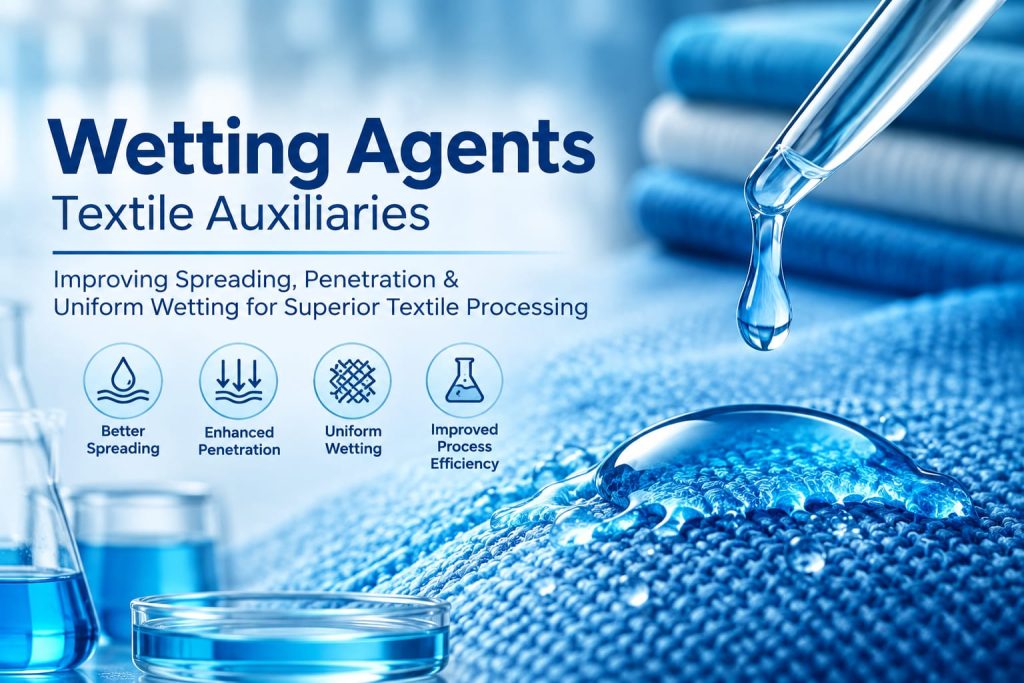
Wetting Agents are essential textile auxiliaries used to improve the wetting, penetration, spreading and uniform distribution of processing chemicals over textile fibres and fabrics. They reduce the surface tension of water and enable faster and more effective contact between the processing liquor and the textile substrate.
During textile processing, efficient wetting is critical for achieving consistent results in processes such as desizing, scouring, bleaching, dyeing, washing and finishing. Our Wetting Agents are designed to promote rapid and uniform wetting of fibres, helping textile manufacturers improve process efficiency, fabric quality and overall reproducibility.
Applications in Textile Processing
Wetting Agents can be used across various stages of textile manufacturing, including:
Desizing: Helps processing liquor penetrate the fabric effectively and supports uniform removal of sizing materials.
Scouring: Improves the penetration of alkaline and cleaning solutions into fibres for efficient removal of oils, waxes, dirt and other impurities.
Bleaching: Promotes uniform penetration and distribution of bleaching chemicals throughout the textile material.
Dyeing: Facilitates rapid and even wetting of fibres, supporting uniform interaction between dyes and the textile substrate.
Washing: Improves the contact between washing liquor and fabric, assisting in the removal of residual chemicals and impurities.
Finishing: Supports uniform application and distribution of finishing chemicals over the fabric surface.
Why Choose Our Wetting Agents?
Our Wetting Agents are designed to support modern textile wet-processing requirements by providing effective wetting and penetration with reliable process performance. They can be selected according to the specific needs of dyeing houses, textile mills, processing units and finishing operations.
For optimum results, the appropriate Wetting Agent grade should be selected according to the textile substrate and process requirements. Dosage, temperature, pH and compatibility with other auxiliaries should be established through suitable technical trials before commercial production.
MSDS Sheet
Industries Served